You are interested in hardware. The candidate next to you may hold a portfolio of work done where the supply chain is densest.
This is 8 days of hardware-native practice on a shared GBA circuit — so the story shifts from “I’m interested” to “here’s what I worked on. In China.”
Buyer: Parent or self-pay young adult 18–25.
Designed to deliver: portfolio pack — solder, repair, design, flight.
Steven: appearances · week run by bilingual lead guide
Fork: already on a company seat that needs floors or tech scouting? See Scale or Frontier.
The week
| Day | City | Theme |
|---|---|---|
| 1 | Shenzhen | Arrival + shock — Huaqiangbei supply chain lens |
| 2 | Shenzhen | Reverse engineer — teardowns, soldering, chip forensics |
| 3 | Shenzhen | Build + program — microcontrollers, hack a toy |
| 4 | Dongguan | Factory deep dive — PCB fab, injection molding, negotiation |
| 5 | Guangzhou | Speed + scale — automated port, fast fashion supply chain |
| 6 | Zhuhai | Energy + future — batteries, drone swarm programming |
| 7 | Hong Kong | Systems thinking — IP layer, portfolio build |
| 8 | Hong Kong | Departure |
What they’ll do
Access classes flex with what opens that week:
Huaqiangbei supply chain walk. Not “look at the lights” — a guided walk through 18 floors of SEG Plaza with a supply-chain lens. Finished products → components → repair tools → ICs. Stop at a stall that sells nothing but one type of capacitor. “This stall does $2 million a year. One product. One stall.”
Component kit dinner. Each delegate receives a bag of 20 random components bought from the market. Task over dinner: identify as many as possible. The delegate who IDs the SMD inductor wins — not a prize, respect. Gamified learning from real, cheap, mysterious parts.
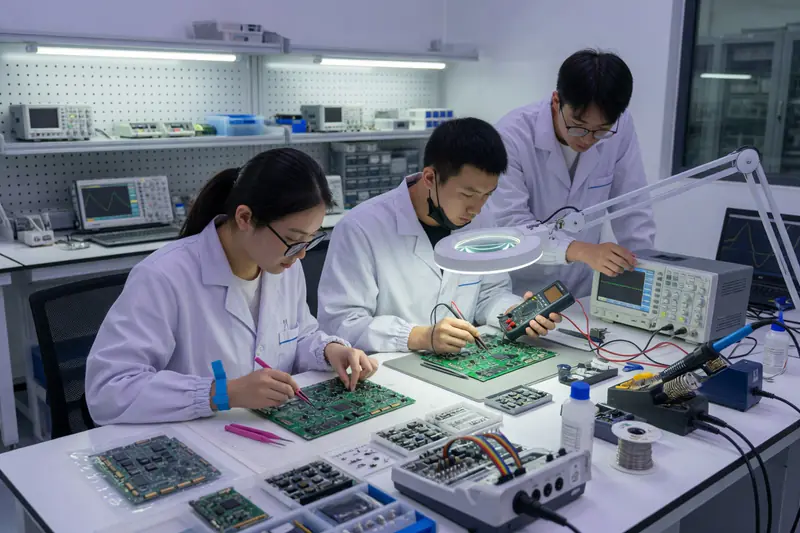
iPhone resurrection lab. In a Huaqiangbei repair stall. Each delegate gets a dead iPhone. Master technician demonstrates diagnosis: multimeter, thermal camera, microscope. Attempt repair — target: get the phone to boot. Success rate ~60%. The moment the Apple logo appears on a phone they fixed themselves is irreplaceable.
Chip forensics. Under a microscope, look at decapped chips. Identify the A-series processor, baseband, NAND flash, PMIC, audio codec, RF front-end. Map each chip to country of origin. “This phone: chips from USA, Korea, Taiwan, Japan, Netherlands, China. Assembled in Shenzhen. No one country can make an iPhone alone.”
Solder your first PCB. Surface-mount and through-hole at a makerspace. Solder an LED flasher circuit or a small FM radio — something that works. Test it. Debug it if it doesn’t. Soldering is a superpower most adults lack.
Program a microcontroller from scratch. ESP32 or Arduino. Breadboard. Sensors. Code in Arduino IDE or MicroPython. “Make an LED blink when the room gets dark.” Extra credit: connect to WiFi and send data to a phone. Code meets hardware. The software/hardware gap disappears.
Hack a toy. Buy cheap RC cars or drones from Huaqiangbei. Replace the controller with an ESP32. Add sensors. Make the RC car follow a line. Make the drone flash patterns. The toy is the platform. The hack is the product.
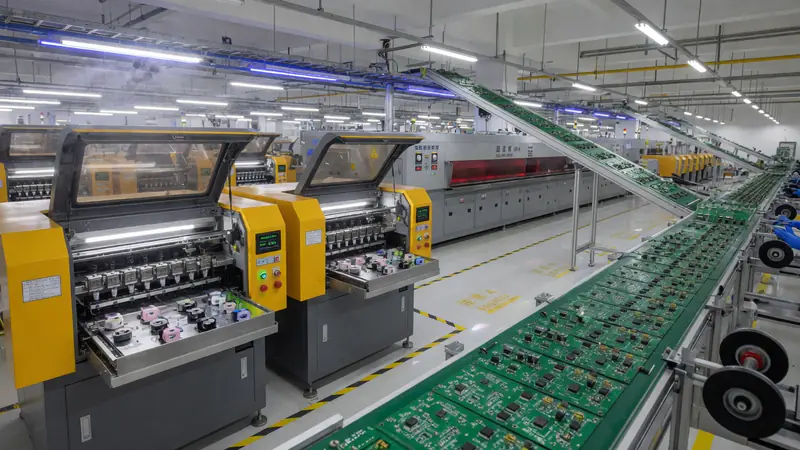
Design and order your own PCB. Tour a PCB fab — Gerber file to finished board. Then each delegate designs a simple PCB in EasyEDA. Submit the design. Five boards manufactured and shipped to their home address, arriving ~2 weeks after the tour. “I can make hardware. China can make it cheap. Distance is dead.”
Injection molding — touch the tooling. See the mold tooling — $10,000–$100,000 blocks of steel precise to 0.01 mm. Watch the press cycle: 15 seconds, a plastic part drops out. Touch the steel mold — solid, heavy, precise — then watch it spit out a part. Hardware is tooling + time.
Factory negotiation simulation. Steven or lead guide plays a factory boss. Delegates are “buyers” from a US company. They need 10,000 units. Negotiate price, MOQ, lead time, payment terms. Pushback: “RMB 15? No. RMB 18. MOQ 50,000. 30% deposit. 45 days.” Role-play with someone who’s done these negotiations for decades.
Nansha automated port — no humans. Tour the Nansha Phase IV automated container terminal. Beidou-guided autonomous trucks. Robot cranes stacking containers 40 m high. Zero humans on the ground. 4.9 million containers per year. Giant robots playing Tetris with shipping containers — and it’s real infrastructure.
Drone swarm programming. Program a fleet of small drones using Python or Scratch. Mission: synchronized flight patterns. Form a diamond. Form a line. Coordinate takeoff and landing. The video of synchronized dance from code they wrote is a personal brand asset.
Build your portfolio. Final session. Each delegate gets: soldered PCB, framed iPhone logic board, custom PCB design files, drone swarm video, venue photos, certificate. Build a simple portfolio page documenting everything. If the week lands, they leave with work to show — not only vacation photos.
What they walk away with
Experience-led portfolio spine (goodwill, not contracted):
- A soldered PCB — surface-mount work most adults never touch
- A framed logic board — tear-down and repair context under real conditions
- A custom PCB design — Gerber files and boards home when fab timing allows
- Drone / swarm programming artifacts when that session runs
- Documented practice — a portfolio page, not only vacation photos
Who runs it
A bilingual lead guide runs the week. Steven aims for appearances at critical spikes. Doors open because relationships are real — not because a brand is promised on a PDF.
How to think about the fee
Compared with years of “I’m interested” without evidence — this week buys documented hardware practice. Early Bird US $8,888.
Pricing
| Early Bird | Standard |
|---|---|
| US $8,888 | US $13,888 |