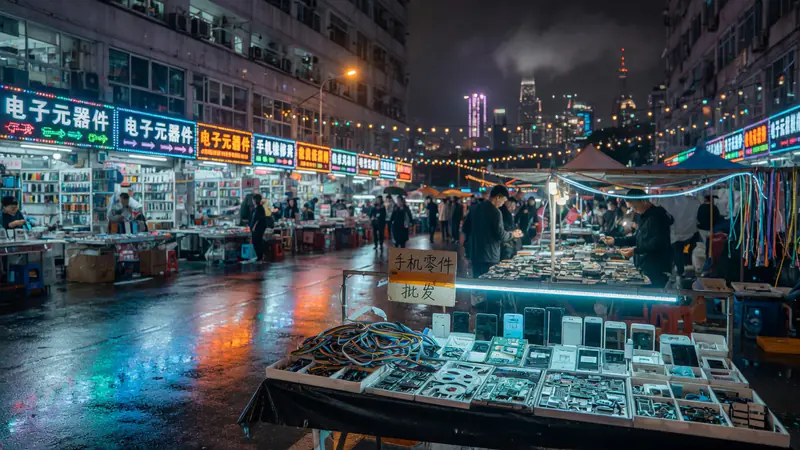
China’s supply chain is not a single “factory tour” asset. It is a living market-plus-floor system: component density you can walk, contract manufacturers who quote in hours, logistics that erase geography, and relationship layers that never appear in a Western RFP template.
This page is the Learn layer — what executives and operators should understand. When you are ready to stand in it, the Visit layer is our Supply Chain (Scale) program.
Definition: what “China supply chain” means on the ground
For Western buyers, “China supply chain” often collapses into a headline — China makes everything — or a fear script. Operators use a different map:
- Component markets where price discovery is public and brutal (Huaqiangbei is the textbook case, not a tourist souvenir street).
- Tiered manufacturing — from small job shops to lights-out lines — that can absorb design changes and volume swings.
- Process literacy — how a bill of materials (BoM) is priced, negotiated, and protected (or leaked).
- Human infrastructure — owners, purchasing managers, and WeChat groups that decide whether your project gets air or dies in a queue.
If you only read analyst notes, you get averages. If you walk the floors with someone who has run them, you get participation literacy: less naïve on quotes, quality, and timing.
Greater Bay Area: why the circuit matters
The public Latest Byte circuit runs Shenzhen · Guangzhou · Foshan · Hong Kong — one bay, two systems, maximum industrial adjacency. Supply-chain density concentrates here because:
- Shenzhen holds the electronics market culture and deep hardware ecosystems.
- Dongguan / Foshan hold volume manufacturing and factory-floor reality (often the real lesson, not the glass-walled showroom).
- Guangzhou links trade, logistics, and regional scale.
- Hong Kong sits on finance, trade documentation, and the edge between systems.
Executives do not need every city for prestige. They need one coherent week that connects market → floor → quote → judgment.
Key company classes (not a guaranteed checklist)
We describe access classes — types of places that typically open — never a fixed brand itinerary. Specific sites flex with what opens that week.
| Class | What you learn | Why it matters |
|---|---|---|
| Electronics market floors | SKU density, MOQ, real-time price | BoMs stop being abstract |
| Contract manufacturer rooms | How quotes are built and gamed | First-timer mistakes get expensive |
| Live production lines | Cycle time, yield, automation mix | “China speed” becomes sensory |
| Logistics / port adjacency | How goods actually leave | Lead times stop being slideware |
| Trade-finance edges (HK) | Letters, terms, risk language | Sourcing meets capital |
Named brands in public discourse (large EV makers, consumer electronics groups, famous markets) are context, not promises. Honesty is the trust product: access density, not a contractual logo list.
How pricing and negotiation actually work
A Western purchasing process often assumes: RFI → RFP → shortlist → audit → award. On the ground, a strong week of immersion surfaces a parallel reality:
- The best price is rarely the first WeChat reply. Face-to-face and relationship history move numbers.
- Quality is a system, not a certificate. You want to see process control, not only a wall of ISO plaques.
- Small suppliers can be strategic for speed; large ones for volume — the right mix depends on your product stage.
- Your BoM is a map of risk. Each line item is a negotiation surface and a leak surface.
Teams that return with a priced BoM and playbook notes (when the week lands) are not buying souvenirs. They are buying less expensive ignorance for the next quarter of decisions.
Government and industrial policy — public-safe framing
Supply-chain resilience sits at the center of China’s 15th Five-Year Plan (2026–2030). The plan elevates advanced manufacturing, new energy, and supply-chain security as Tier-1 strategic priorities. For visiting executives, the practical read is:
- Policy sets direction and capital gravity (clusters form where incentives and infrastructure align).
- Operators still win or lose on execution on the floor.
- Western narratives that only say “subsidy” miss process capability that has compounded for decades.
SPD participates annually in 莲博会 (Lianbo Expo) — the China International Supply Chain Expo organized by 贸促会 (CCPIT, the China Council for the Promotion of International Trade) in Beijing. This institutional connection — trade promotion at the national level, supply-chain exhibition at the expo — anchors the supply-chain knowledge on this page in real operator participation, not desk research.
You do not need a politics seminar to source well. You do need to stop treating the GBA as a black box.
What visitors can typically see
Sensory details that transfer:
- Flux in the air on a running SMT line — not a trade-fair booth.
- Stall-level negotiation for connectors and ICs — price discovery you can hear.
- A factory owner’s unfiltered dinner conversation — what kills margins, how they vet foreign clients.
- Night markets of components under neon — supply chain as place, not spreadsheet.
Access honesty: venues flex. What opens that week is the product. Marketing that guarantees named brands is a different business — and not this one.
How this connects to other China industries
Supply chain is the base layer under almost everything else:
- Robotics needs actuators, sensors, and automation suppliers.
- EV & batteries sit on materials, cells, and gigafactory logistics.
- Hardware engineering literacy starts with components you can hold.
- Advanced manufacturing is the floor that turns designs into volume.
Seeing only one vertical without supply-chain context is how boards get surprised by cost and lead time.
From learning to visiting
| Intent | URL |
|---|---|
| Learn | this page |
| Visit | China Supply Chain Tour — Scale |
| Compare | All programs |
| Buy conversation | Booking · Pricing |
Primary pathway: if your organization needs a delegate who can source, negotiate, and brief — not collect photos — start with Scale.
Operator note
After enough years on Chinese floors, the “mystery” shrinks. The system has gears: market layers, factory tiers, relationship capital, and speed culture. Once you have seen the gears, fear drops and working with the system becomes possible. That transfer is why this knowledge layer exists — and why the immersion is eight days of density, not a city checklist.