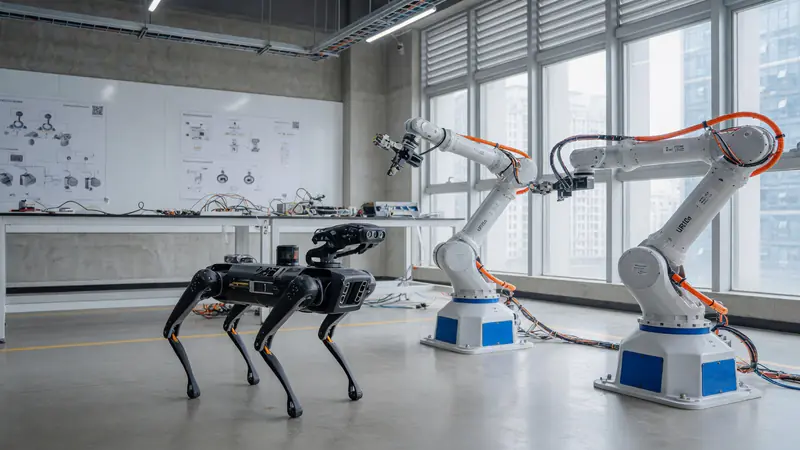
China’s robotics story is not only “humanoids on stage.” It is automation becoming infrastructure: industrial arms on welding lines, collaborative robots taught by hand-guiding, quadrupeds that refuse to stay fallen, and — when access opens — lights-out floors where the lights stay off because no human needs to see.
This is the Learn layer. To visit the stack, see the Deep Tech (Frontier) program.
Definition: robotics as an industrial system
Treat robotics as four overlapping layers:
- Industrial robots — high-speed, high-precision arms in welding, painting, assembly, palletizing.
- Collaborative robots (cobots) — force-limited arms designed to work near people; often programmed by demonstration.
- Mobile / quadruped platforms — inspection, logistics, demo spectacle that still teaches real actuators and SLAM.
- Humanoids — high media attention; uneven commercial maturity; still worth seeing as a trajectory signal when access opens.
Boards that only consume launch videos miss the middle: factories that already run robots at production tempo.
Shenzhen and GBA robotics ecosystem
The Greater Bay Area packs:
- Component supply for motors, sensors, controllers — adjacency that shortens iteration.
- Electronics manufacturing culture that treats robots as another production tool, not a museum piece.
- Startup and scale-up density where quadruped and humanoid teams cluster near talent and suppliers.
- Deployment customers — factories willing to automate under cost and quality pressure.
Shenzhen is the public shorthand. Dongguan often holds the floor truth. Guangzhou and the wider circuit add autonomous systems, logistics, and energy adjacencies that robotics depends on.
Company classes executives should map
Again: classes, not guarantees.
| Class | Typical learning | Board translation |
|---|---|---|
| Quadruped lab / demo | Actuators, gait, robustness | Hardware real vs vaporware |
| Industrial robot line | Cycle time, precision, labor substitution | Automation ROI is physical |
| Cobot showroom | Kinesthetic programming | Deskilled automation is real |
| Lights-out / dark factory | Full automation density | 24/7 without romanticism |
| Humanoid lab (when open) | DOF, hands, balance | Timeline skepticism with evidence |
Public conversation names many brands. Operators care less about logos than about whether the system runs without a trade-show script.
Manufacturing clusters and deployment logic
Robotics in China is pulled by manufacturing demand:
- Labor cost and demographic pressure make automation a line-item strategy, not a pilot vanity.
- Electronics and EV lines create continuous need for precision assembly and material handling.
- “China speed” is partly robot + process + shift culture, not only overtime mythology.
For Western CTOs and product leaders, the strategic question is rarely “will robots exist?” It is: where is iteration fastest, and who has the supply chain to ship hardware?
Policy and industrial priority — 15th Five-Year Plan anchor
Robotics occupies two tiers in China’s 15th Five-Year Plan (2026–2030): Tier 1 — Strategic Emerging Industry (industrial and service robots as declared pillars), and Tier 2 — Future Industries (embodied intelligence including humanoids, listed alongside quantum and 6G as next-growth bets).
For visitors, the practical takeaway:
- Capital and attention flow toward automation and embodied AI at declared-priority velocity.
- Ground truth still lives on floors, not in slogans.
- A week of access beats a year of second-hand commentary for high-stakes bets.
What visitors can typically see and feel
- A yellow industrial arm welding points faster than any human welder’s steady hand — then the quiet of a line that no longer needs twelve people at that station.
- Cobots you program by dragging through waypoints — thirty minutes from novice to useful motion.
- A quadruped that self-rights after a kick — actuators and control loops made visceral.
- A dark factory narrative made real: machines running, lights low, engineers watching screens.
Honesty line: humanoid labs and certain AV demos are aspirational access classes. We never sell unbooked venues as fixed itinerary items.
Entity graph — how robotics connects
- Advanced manufacturing — where robots earn their keep.
- EV & batteries — automation-heavy lines and energy systems.
- Supply chain — the parts and CMs that make robots buildable.
- Hardware engineering — PCB and mechatronics literacy for the people who will build next.
Frontier program weeks often touch batteries, AI, and autonomous systems in the same bay — robotics is the visible spine.
From learning to visiting
| Intent | URL |
|---|---|
| Learn | this page |
| Visit | China Deep Tech Tour — Frontier |
| Related youth pathway | Makers (robot dogs / build culture) |
| Buy conversation | Booking |
If your mandate is real-vs-vaporware for a board, Frontier is the visit layer. If you only need market literacy, stay on this page — then decide.
Closing judgment
The uneven future is already distributed. The question for Western decision-makers is not whether China has robots. It is whether your organization has anyone who has stood next to the stack long enough to brief with authority. That is industrial intelligence — and it is why this page exists above the tour product, not as a keyword shell.