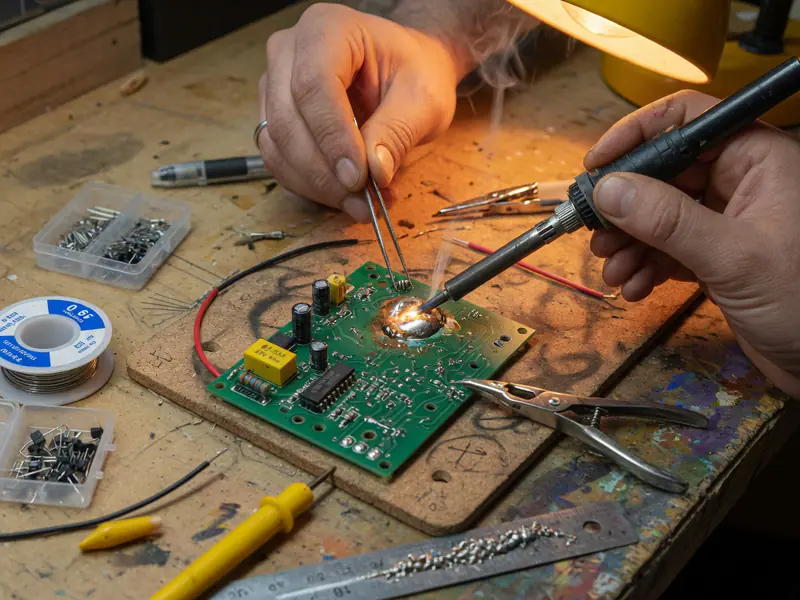
Hardware engineering in China is not a university elective with a tidy kit. It is a city that sells the bill of materials on foot, factories that turn boards into products overnight, repair cultures that refuse planned obsolescence, and a generation of builders who treat soldering as literacy.
This page is Learn. Visit pathways: Hardware Engineering (Engineers) and Makers.
Definition: hardware literacy as a China specialty
Western hardware education often peaks at theory, simulation, and carefully scoped lab kits. The GBA offers something else:
- Component markets — find the part, negotiate the price, learn the substitute.
- PCB and assembly culture — design → fab → assembly loops measured in days, not semesters.
- Repair and reverse culture — products opened, fixed, understood.
- Factory adjacency — see what “design for manufacture” means when the line is real.
- Mechatronics playgrounds — drones, robots, and embedded systems you can fly or crash and iterate.
The outcome parents and young engineers want is not a certificate. It is artifacts and confidence: boards, builds, video proof, a portfolio no lecture hall can match.
Shenzhen hardware ecosystem
Shenzhen’s public identity as a hardware capital rests on:
- Huaqiangbei — multi-floor, multi-building electronics density; IC traders, connectors, modules, repair shops.
- Maker and prototype culture — small runs, fast turns, community knowledge.
- Upstream/downstream integration — the same city cluster that sources parts can assemble products.
- Talent mix — engineers, traders, factory liaisons, and operators in one conversation network.
Standing in Huaqiangbei at night — neon, stalls, people moving with purpose — is an education in how global electronics actually feels. Flux, heat, negotiation volume: sensory memory that sticks longer than slides.
Skills and access classes
| Class | Transfer | Typical audience |
|---|---|---|
| Market sourcing sprint | BoM thinking, price, MOQ | Youth + young adult |
| Soldering / assembly benches | Hands-on craft | Makers / Engineers |
| PCB design → board | Design-for-fab loop | Engineers |
| Drone / robot build-fly | Systems integration | Both youth programs |
| Factory / lab immersion | Manufacture reality | Engineers + companies |
These are experience classes, not fixed day stamps. What opens that week wins.
Why companies should care (not only parents)
Hardware engineering literacy is not only a teen product story:
- Product managers who have never walked a CM floor mis-scope timelines.
- Embedded engineers who only know cloud stacks misread hardware risk.
- Founders who cannot price a BoM get destroyed in supplier conversations.
Scale and Frontier serve company mandates; this industry page explains the skill substrate those programs assume someone on the team should have.
Culture: repair, speed, and “hold the thing”
Chinese hardware culture often prizes:
- Speed of iteration over perfect first specs.
- Physical proof over pitch decks.
- Repair and reuse ecosystems that keep components alive.
For a 15–17 year old, that can mean: I made this. In China.
For an 18–25 year old: a portfolio pack — solder, repair, PCB, flight code.
For a parent: evidence that the belief investment was not another screen-based camp.
Entity graph
- Supply chain — markets and CMs as the economic layer of hardware.
- Robotics — mechatronics and automation as career adjacency.
- Advanced manufacturing — what happens after prototype.
- EV & batteries — power systems and high-stakes electronics.
From learning to visiting
| Intent | URL |
|---|---|
| Learn | this page |
| Visit (18–25) | Engineers |
| Visit (teens 15–17) | Makers |
| China hub | /en/china/ |
| Buy conversation | Booking |
Closing
Hardware is how China became industrial gravity. Teaching the next generation — or re-teaching a company team — requires floors and markets, not only MOOCs. That is the industrial intelligence story under the youth programs: China as the place where making becomes real.